
Middle Tennessee Tree Field Guide
A Field Guide to Nashville's Most Common Trees
By Frank Hartford
Nashville sits in the Central Basin of Middle Tennessee, where limestone-influenced soil, native hardwood forest, street trees, and builder-planted ornamentals all share the canopy.
Knowing the species helps explain what you are seeing. A tulip poplar's height, an eastern red cedar's drought tolerance, and a willow oak's storm behavior each lead to different pruning and maintenance decisions.
This is a homeowner field guide, not a botanical key. When health or structure is uncertain, pair identification with an arborist assessment.
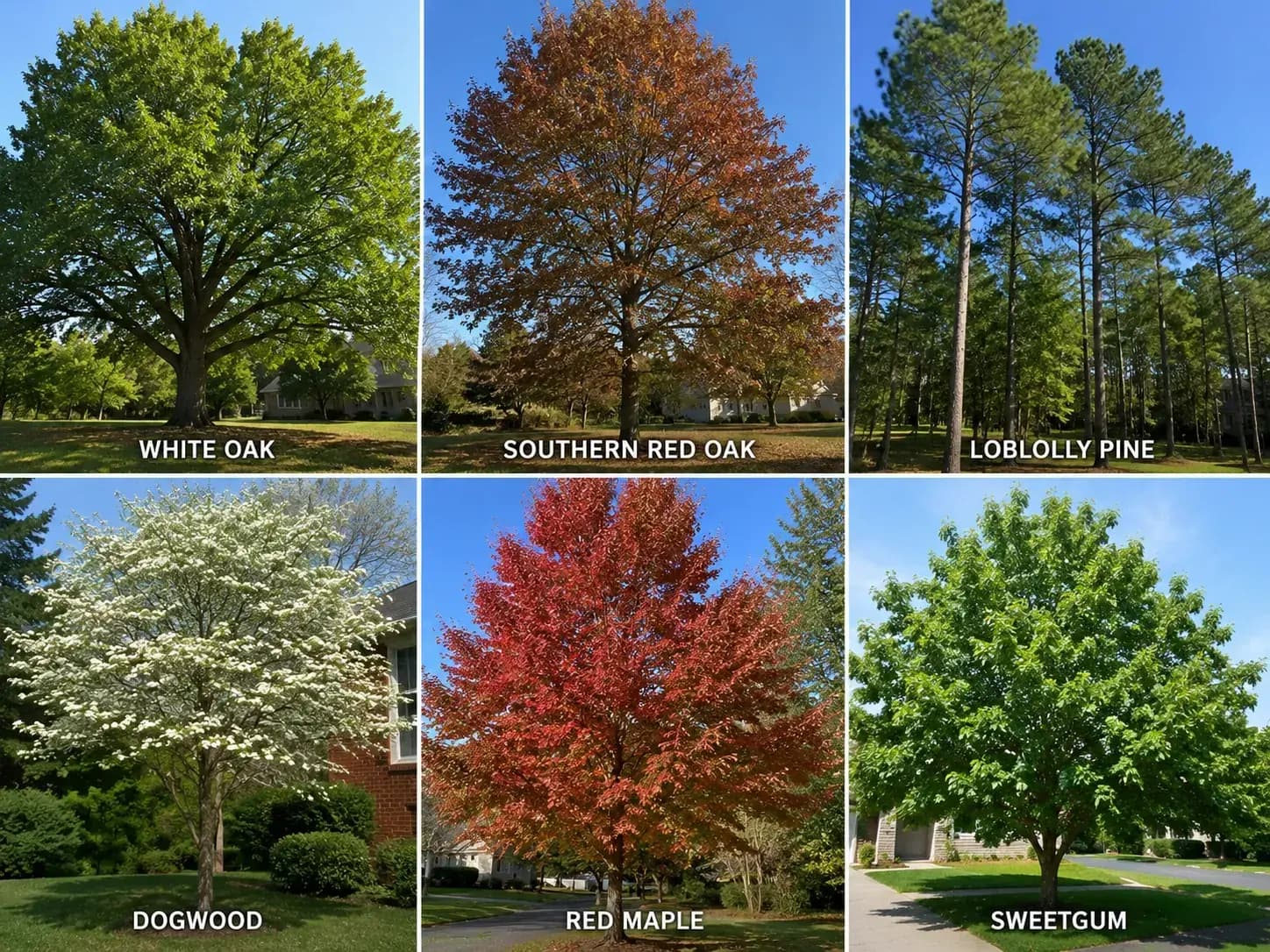
Trees That Shape the Music City Canopy
These species and groups appear repeatedly from Nashville's historic neighborhoods to the lakes and the surrounding counties.
Tulip poplar
Tennessee's state tree and one of the tallest hardwoods in the region, with distinctive squared-off leaves and straight trunks. Rapid height and brittle storm-damaged limbs make canopy inspections useful near structures.
Willow oak
A signature shade tree in older Nashville neighborhoods, with narrow, unlobed leaves and a broad mature crown. Older specimens need thoughtful end-weight reduction and roof clearance — not topping.
Eastern red cedar
A tough Central Basin native that thrives on thin, rocky soil. Common in fencerows and older lots; watch for co-dominant stems and storm lean on larger specimens.
White oak
Slow-growing, long-lived, and valuable for wildlife. Rounded leaf lobes and pale, plated bark help identify it. Preserve roots during construction and use structural tree trimming sparingly.
Red maple
A fast-growing native found in yards and wetter sites. Opposite branching and red buds are useful clues. Early pruning can correct crowded unions before they become heavy competing stems.
Hackberry
Extremely common across Nashville with warty, ridged bark and a tendency toward included bark and deadwood. Regular deadwood removal keeps these tough trees safer over drives and roofs.
Bradford (Callery) pear
An invasive ornamental with weak branch unions that split in storms. Replacement with a better-adapted native is often recommended once decline or breakage begins.
Identification Changes the Care Plan
Species influences mature size, decay patterns, drought response, pruning tolerance, and the season when work is least stressful.
It also changes what counts as normal. Peeling cedar bark may be expected while the same look signals decline on another tree; surface roots can be characteristic rather than evidence of failure.
Before heavy pruning, compare the tree's needs with our Nashville pruning calendar. If structure or health is questionable, review the hazard checklist.
Photograph the Clues That Matter
For identification, capture the whole tree, branching pattern, bark, leaves or needles, fruit or cones, and buds when available.
Include the site around it. Soil depth over limestone, available root space, sun exposure, and nearby construction often explain more about condition than a leaf close-up.
Send those photos with your project details and we can point you toward pruning, monitoring, or another appropriate service.
Nashville Tree Identification Questions
What is the most common large tree in Nashville?
Tulip poplars, willow oaks, hackberries, and red maples are all widespread across the metro, with eastern red cedar especially common on the thin, rocky soils of the Central Basin.
Are Bradford pears a problem in Tennessee?
Yes. Bradford pear is a cultivar of invasive Callery pear. Its weak branch unions commonly split, and replacement with a better-adapted native is often recommended when decline begins.
Can a tree be identified from one leaf?
Sometimes, but bark, buds, branching arrangement, fruit, and overall form make identification much more reliable. Hybrids and ornamental cultivars can be especially tricky.
Does species matter when deciding to remove a tree?
Yes, but species alone is never the reason. Expected lifespan, defect patterns, site fit, health, and the targets beneath the tree all contribute to the decision.
Keep reading
Related guides & services
Useful next steps from Nashville Tree Co. across Nashville.
Need Help Reading Your Trees?
Send photos of the tree and the concern you are seeing.
We can help narrow the species and recommend tree trimming, an arborist assessment, or removal when warranted.